
 日本語
日本語
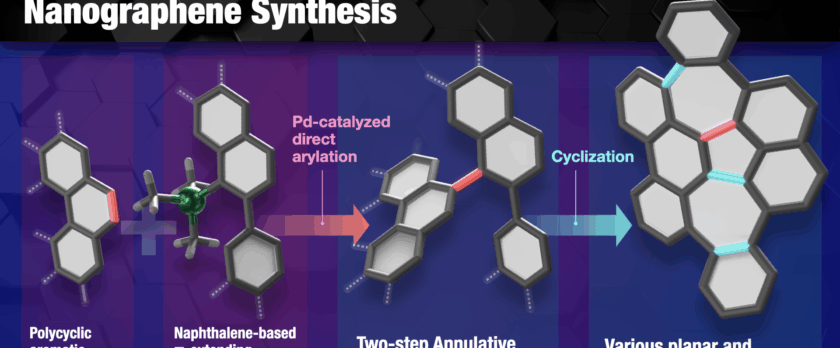
Our paper “Diversity-Oriented Two-step Annulative π-Extension Enables Access to Structurally Complex Nanographenes” has been published in Angewandte Chemie International Edition(Link to paper).
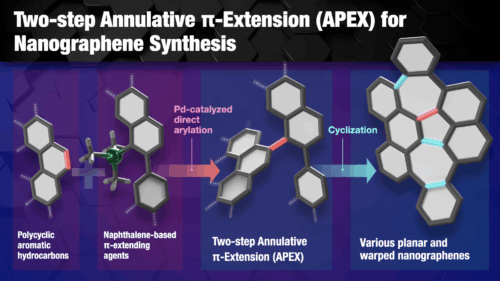
Diversity-Oriented Two-step Annulative π-Extension Enables Access to Structurally Complex Nanographenes
Honami Katsuragawa, Yoshifumi Toyama, Shota Mikawa, Kou P. Kawahara, Hideto Ito, Kenichiro Itami
Angew. Chem. Int. Ed. 2026, 65, Early View.
DOI: 10.1002/anie.2205198
Image was created by Dr. Issey Takahashi (RIKEN)
We have developed a new method for synthesizing diverse and complex nanographenes from unfunctionalized polycyclic aromatic hydrocarbons (PAHs) in only two steps. The method, termed a two-step annulative π-extension (APEX) strategy, involves the palladium-catalyzed direct attachment of naphthalene frameworks with diverse structures to unfunctionalized PAHs, followed by oxidative cyclization. Conventional APEX methods have been limited by the small range of available π-extension reagents, restricting the structural diversity of accessible nanographenes. In contrast, the present method enables the introduction of sterically congested aromatic units and provides access to both planar and curved nanographenes composed of eight to ten fused rings. Notably, we succeeded in synthesizing a highly curved nanographene with negative curvature, featuring a unique combination of five-, six-, and seven-membered rings, and elucidated its three-dimensional structure, aromaticity, and absorption and emission properties.
This work significantly expands the structural space of nanographenes beyond what has been readily accessible by conventional synthetic methods and establishes a new platform for exploring previously unknown optical and electronic functions arising from molecular structure. Beyond the efficient synthesis of known compounds, this approach also offers a powerful form of exploratory synthesis for discovering previously inaccessible carbon frameworks and properties. By systematically establishing relationships between the number and connectivity of fused rings, molecular curvature, and properties such as absorption, emission, redox behavior, charge transport, and molecular assembly, this strategy may ultimately enable the design of nanographenes starting from desired functions. In the longer term, it is expected to accelerate the discovery of molecules suited for organic semiconductors, light-emitting materials, optical sensors, solar cells, and other energy-conversion applications, contributing to the development of next-generation carbon materials with atomically precise structures. Integration with computational chemistry and data science should further enable promising candidates to be efficiently selected from vast structural spaces and advanced to synthesis and property evaluation(Link to press release).
Congratulations to Honami and the entire team!