
 日本語
日本語
Atomic-precision π-driven peptide hydrogel nanofibers with ordered water channels
Ayaka Ueda, George Broutzakis, Alexander Neuhaus, David Ens, Dominik Mählmann, Lisa Schlichter, Hideya Kono, Akiko Yagi, Kazuma Amaike, Christos Gatsogiannis, Bart Jan Ravoo, and Kenichiro Itami
Nature Communications, 2026, 17, 7622.
DOI: 10.1038/s41467-026-75984-9
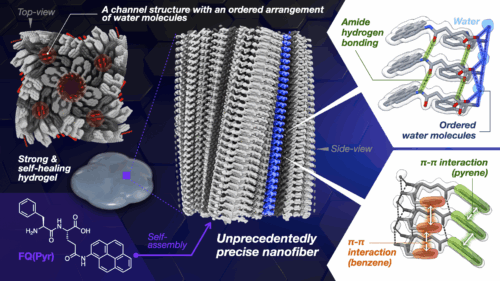
Peptide self-assembly is primarily driven by hydrogen bonding together with π–π interactions between aromatic moieties. A common strategy for reinforcing peptide hydrogels is the introduction of large aromatic groups at the peptide termini, thereby enhancing intermolecular π–π interactions. However, terminal modification masks the intrinsic peptide termini, limiting their native electrostatic properties and interactions with surrounding water molecules. We hypothesized that preserving the peptide termini while introducing a π-extended aromatic unit as a side-chain substituent would enable the simultaneous utilization of terminal hydration and electrostatic interactions together with strong π-driven molecular assembly, thereby promoting the formation of highly ordered nanostructures in aqueous environments.
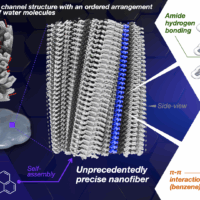
To test this concept, we designed and synthesized a novel dipeptide, FQ(Pyr), consisting of phenylalanine and glutamine with a pyrene moiety, a representative π-extended aromatic hydrocarbon, introduced at the side chain. Upon pH modulation, FQ(Pyr) spontaneously self-assembled into uniform helical nanofibers, which further formed transparent supramolecular hydrogels through three-dimensional entanglement. The resulting hydrogel exhibited excellent self-healing behavior, recovering its homogeneous gel state after mechanical disruption.
Furthermore, the three-dimensional structure of the FQ(Pyr) nanofibers was determined by cryogenic electron microscopy (cryo-EM) at a resolution of 1.7 Å, representing one of the highest-resolution structural analyses achieved for a synthetic supramolecular material. The cryo-EM structure revealed that the peptide molecules are packed with remarkable regularity to form nanofibers containing continuous water-filled channels. In addition, the molecules adopt a unidirectional arrangement along the fiber axis, generating macroscopic polarization throughout the supramolecular assembly.
This study demonstrates a molecular design strategy that simultaneously exploits the intrinsic polarity of peptide termini and the strong intermolecular interactions provided by π-extended aromatic units to produce highly ordered and functional supramolecular hydrogels. The resulting materials combine the mechanical softness characteristic with unique electronic properties, providing a versatile platform for the development of next-generation soft materials. Because this design principle is not limited to FQ(Pyr), it should be broadly applicable to a wide range of peptide sequences and π-conjugated aromatic systems. Moreover, the water-channel architecture and unidirectionally polarized nanostructures identified in this study have potential to provide a structural basis for developing functional soft materials, including selective ion- and water-transporting nanochannels, piezoelectric soft materials, and bioactive scaffolds capable of interacting with cells and biomolecules. Finally, this work highlights cryo-EM as a powerful structural biology tool that extends beyond proteins and other biological macromolecules to enable atomic-resolution structural characterization of synthetic supramolecular materials.
This work is the result of a fruitful collaboration with Professor Bart Jan Ravoo and Professor Christos Gatsogiannis at the University of Münster. A major impetus for this collaboration was the research stay of our research scientist, Dr. Ayaka Ueda, at the University of Münster, where she carried out part of the work (link to the University of Münster press release). The collaboration has continued to develop and is now expanding into a number of related research directions.
This study is also closely connected to the JST Advanced International Collaborative Research Program (ASPIRE). A joint press release was issued by RIKEN and JST (link to the RIKEN/JST joint press release).
Image and movie created by Dr. Issey Takahashi (RIKEN)